

Client instance. This can be done by setting the hide_inputs and hide_outputs parameters on the Client object (hideInputs and hideOutputs in TypeScript).
For the example below, we will simply return an empty object for both hide_inputs and hide_outputs, but you can customize this to your needs.
Rule-based masking of inputs and outputs
This feature is available in the following LangSmith SDK versions:
- Python: 0.1.81 and above
- TypeScript: 0.1.33 and above
create_anonymizer / createAnonymizer function and pass the newly created anonymizer when instantiating the client. The anonymizer can be either constructed from a list of regex patterns and the replacement values or from a function that accepts and returns a string value.
The anonymizer will be skipped for inputs if LANGSMITH_HIDE_INPUTS = true. Same applies for outputs if LANGSMITH_HIDE_OUTPUTS = true.
However, if inputs or outputs are to be sent to client, the anonymizer method will take precedence over functions found in hide_inputs and hide_outputs. By default, the create_anonymizer will only look at maximum of 10 nesting levels deep, which can be configured via the max_depth parameter.
Improving the performance of
anonymizer API is on our roadmap! If you are encountering performance issues, please contact support via support.langchain.com.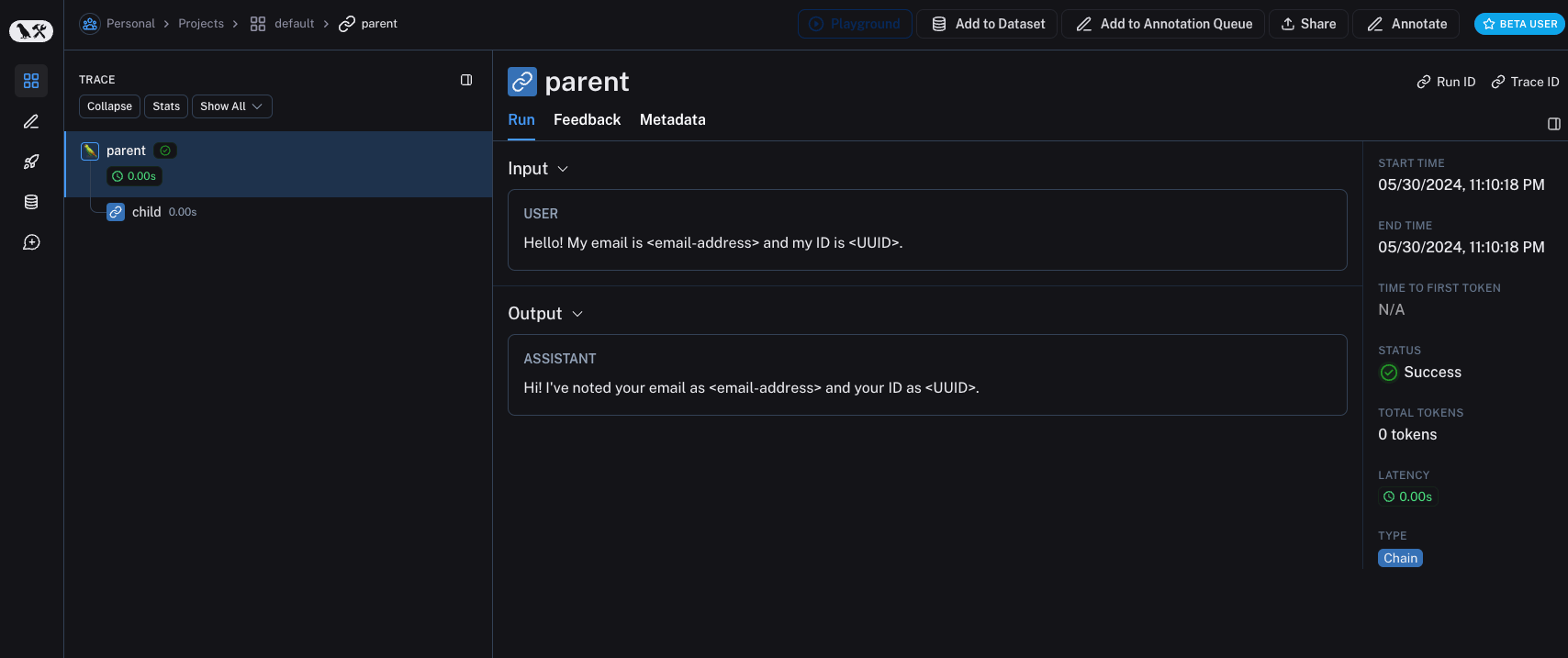
hide_inputs and hide_outputs parameters to achieve the same effect. You can also use these parameters to process the inputs and outputs more efficiently as well.
Processing Inputs & Outputs for a Single Function
The
process_outputs parameter is available in LangSmith SDK version 0.1.98 and above for Python.process_inputs and process_outputs parameters of the @traceable decorator.
These parameters accept functions that allow you to transform the inputs and outputs of a specific function before they are logged to LangSmith. This is useful for reducing payload size, removing sensitive information, or customizing how an object should be serialized and represented in LangSmith for a particular function.
Here’s an example of how to use process_inputs and process_outputs:
process_inputs creates a new dictionary with processed input data, and process_outputs transforms the output into a specific format before logging to LangSmith.
For asynchronous functions, the usage is similar:
hide_inputs and hide_outputs) when both are defined.
Quick starts
You can combine rule-based masking with various anonymizers to scrub sensitive information from inputs and outputs. In this how-to-guide, we’ll cover working with regex, Microsoft Presidio, and Amazon Comprehend.Regex
The implementation below is not exhaustive and may miss some formats or edge cases. Test any implementation thoroughly before using it in production.
 The non-anonymized run will look like this in LangSmith:
Microsoft Presidio
The implementation below provides a general example of how to anonymize sensitive information in messages exchanged between a user and an LLM. It is not exhaustive and does not account for all cases. Test any implementation thoroughly before using it in production.
 The non-anonymized run will look like this in LangSmith:
Amazon Comprehend
The implementation below provides a general example of how to anonymize sensitive information in messages exchanged between a user and an LLM. It is not exhaustive and does not account for all cases. Test any implementation thoroughly before using it in production.
 The non-anonymized run will look like this in LangSmith: